The must-see temples of Chiang Rai

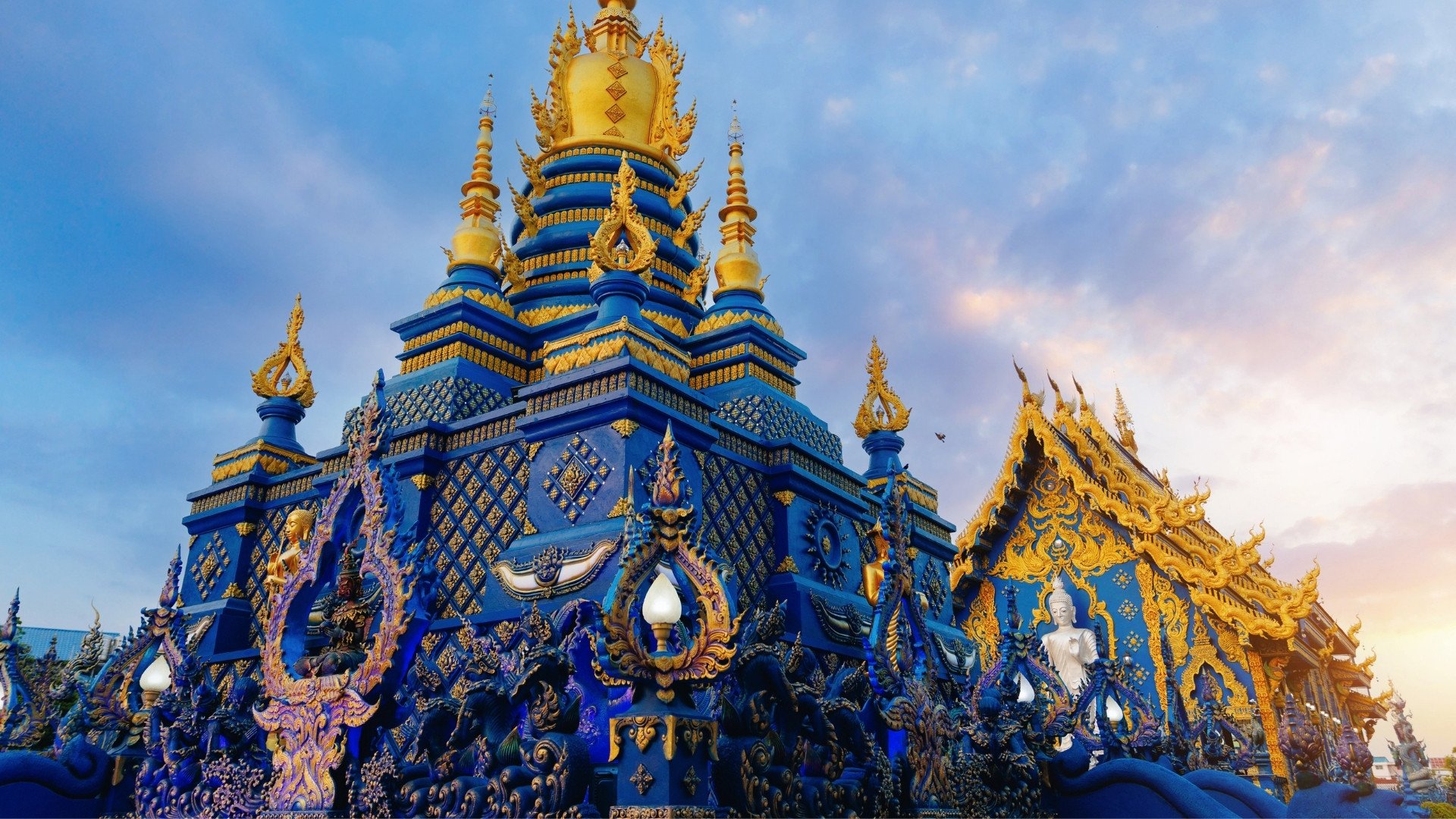
Chiang Rai, in Thailand, holds a surprise for first-time visitors. Not much is expected from this northern city, which is often overshadowed by Chiang Mai. And then, you stumble upon a completely white temple encrusted with mirrors, another of a sapphire blue that exists nowhere else in Thailand, and a 70-meter goddess towering over the rice fields. In just a few decades, the city has become one of the most original places in the country. What makes these temples even more interesting is that they look like nothing else known. They are neither ruins nor frozen monuments. They are living works, driven by visionary artists and monks, that continue to evolve. But they are also active places of worship. Monks live there, worshippers pray there every morning, and every architectural detail carries a precise spiritual meaning. Knowing what you are looking at changes the entire visit.
How to get to Chiang Rai
From Chiang Mai, the Green Bus company connects the two cities from Bus Terminal 3, several times a day. The journey takes between 3 and 5 hours depending on the ticket class, starting at around 200 baht. The route goes through mountain landscapes that are well worth the detour.
From Bangkok, flying is clearly the best option. A flight of about 1 hour and 30 minutes, notably with AirAsia or Nok Air. Mae Fah Luang Airport is 8 km from the city center, served by a local bus for 20 baht from the arrivals area.
On-site, renting a scooter costs about 200 baht a day. This is the easiest way to go from one temple to another, as they are all within a 15 km radius around the center. For those who prefer not to drive, a day-long tuk-tuk is a good alternative. Expect to pay 800 to 1,000 baht depending on the itinerary.
Wat Rong Khun: the White Temple
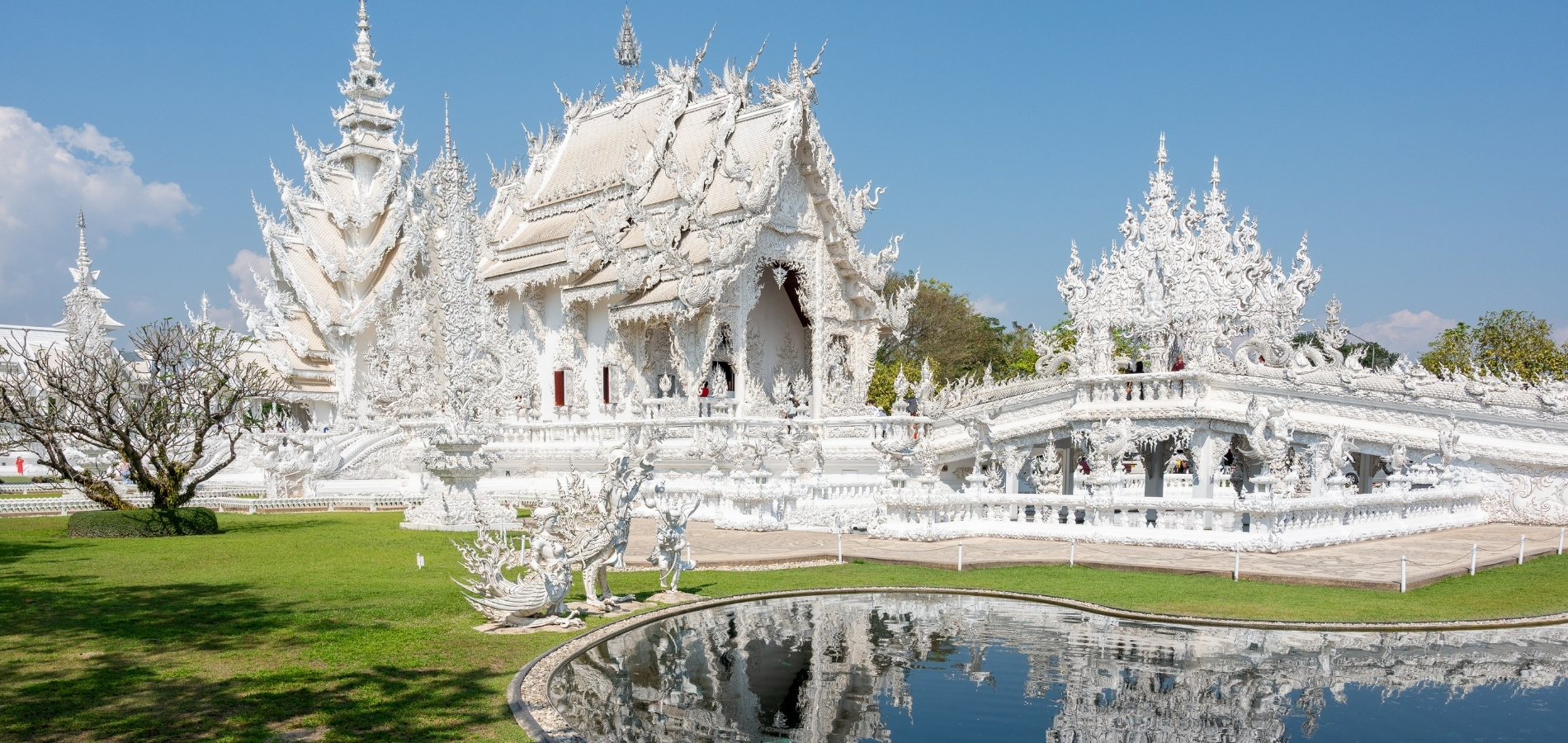
This is the most recognizable image of Chiang Rai. Perhaps even of the entire Thai north. Wat Rong Khun, which everyone calls the White Temple, is covered in white plaster and encrusted with thousands of mirror fragments. In bright sunlight, it sparkles. No other temple in Thailand looks like it.
An artist, a tribute, an endless project
There is nothing ancient about this temple. Its construction began in 1997, at the initiative of an artist originally from Chiang Rai, Chalermchai Kositpipat. His project: to pay tribute to King Bhumibol and to offer his city an extraordinary monument.
He financed the work using his own funds, refusing all donations exceeding 10,000 baht to avoid depending on anyone and to make no concessions regarding his vision. The completion of the work is estimated to be around 2070, very likely after his death. The White Temple is a work in perpetual progress, and that is precisely what makes it unique.
What you will see
To reach the main building, you cross a bridge over a pond dotted with hands reaching toward the sky. These hands represent suffering souls crying out for their deliverance, a Buddhist image of the cycle of rebirths and the passage between the world of desires and that of awakening.
The white symbolizes the purity of Buddha. The thousands of mirror fragments, the wisdom that radiates into the world.
Inside, a surprise awaits those who do not expect it. The murals blend Buddhist iconography with contemporary culture: Batman, science fiction movie characters, and commentaries on current world issues stand alongside representations of karma and awakening. This is the deliberate choice of the artist, who is convinced that spirituality must dialogue with its time.
Good to know: photos are forbidden inside the main building.
Our advice: arrive right at opening time at 8:00 AM. Tour groups show up mid-morning, and the site quickly becomes very crowded. Early in the morning, the light on the mirrors is also much more beautiful.
Practical info
The temple is 13 km south of Chiang Rai, about fifteen minutes by scooter. A songthaew, a shared local bus, leaves from Terminal 1 for 20 baht. By tuk-tuk from the center, expect 300 baht round trip including waiting time.
The entrance fee is 200 baht. Open Monday to Friday from 8:00 AM to 5:00 PM, Saturday and Sunday until 5:30 PM. Allow 1 hour and 30 minutes for the full visit: temple, bridge, gardens, painting museum, and gallery. 45 minutes is enough if you are in a hurry.
The site is highly accessible for families: flat ground, generous space. The extravagant sculptures captivate children, and teenagers often love the quirky side of the place.
Wat Rong Suea Ten: the Blue Temple
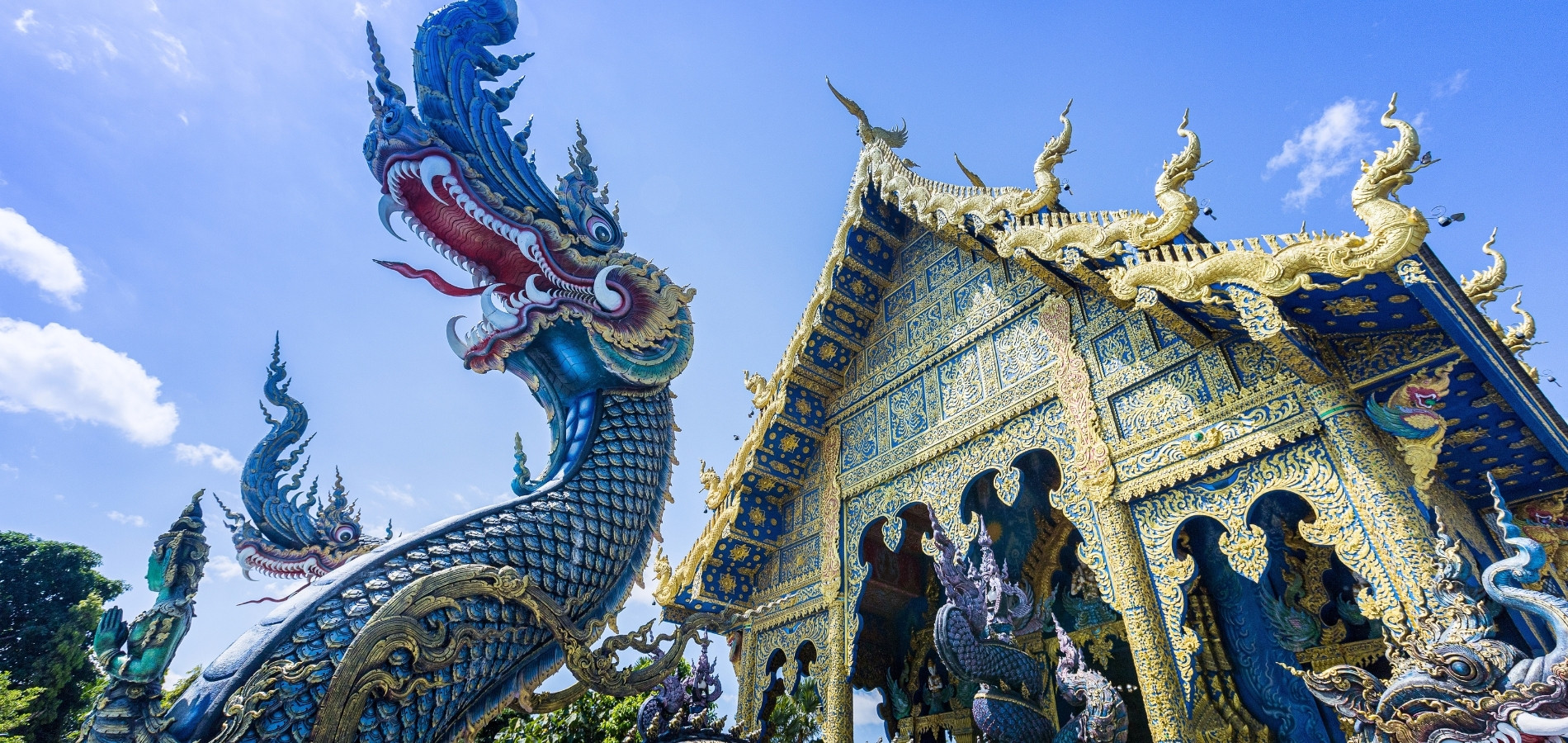
6 km north of the city center, there is a temple that many travelers miss out on, due to lack of time or information. Its color is its primary signature. Not a pastel blue nor a pale blue: a deep sapphire blue that pops against the Chiang Rai sky. From the facade down to the smallest details of the interior murals, everything is bathed in this intense hue, enhanced by flamboyant gilding.
The story of the tigers
The name of the temple means "the house of the leaping tiger." This is not a metaphor.
For a long time, this abandoned wat served as a playground for tigers that regularly crossed the nearby river to rest there, much to the dismay of the villagers. These felines have since disappeared from the territory, but they left their name to the place.
The main building was only completed in 2016. Its creator, Phuttha Kabkaew, is a student of the master of the White Temple. One finds a very similar style in the interior murals: detailed paintings representing the Buddhist heavens, with a large white porcelain Buddha reigning in the center of the prayer hall. The contrast between this immaculate white and the electric blue that surrounds it is striking.
The atmosphere there is calmer than at the White Temple. Fewer groups, more local worshippers.
We recommend coming in the late afternoon. The temple is open until 8:00 PM, and as soon as night falls, the lighting further accentuates the deep blue of the facades. An image difficult to forget.
Practical info
In the Rim Kok sub-district, about ten minutes by scooter from the center. Entrance is free. Open every day from 7:00 AM to 8:00 PM.
Wat Huay Pla Kang: the 70-meter goddess
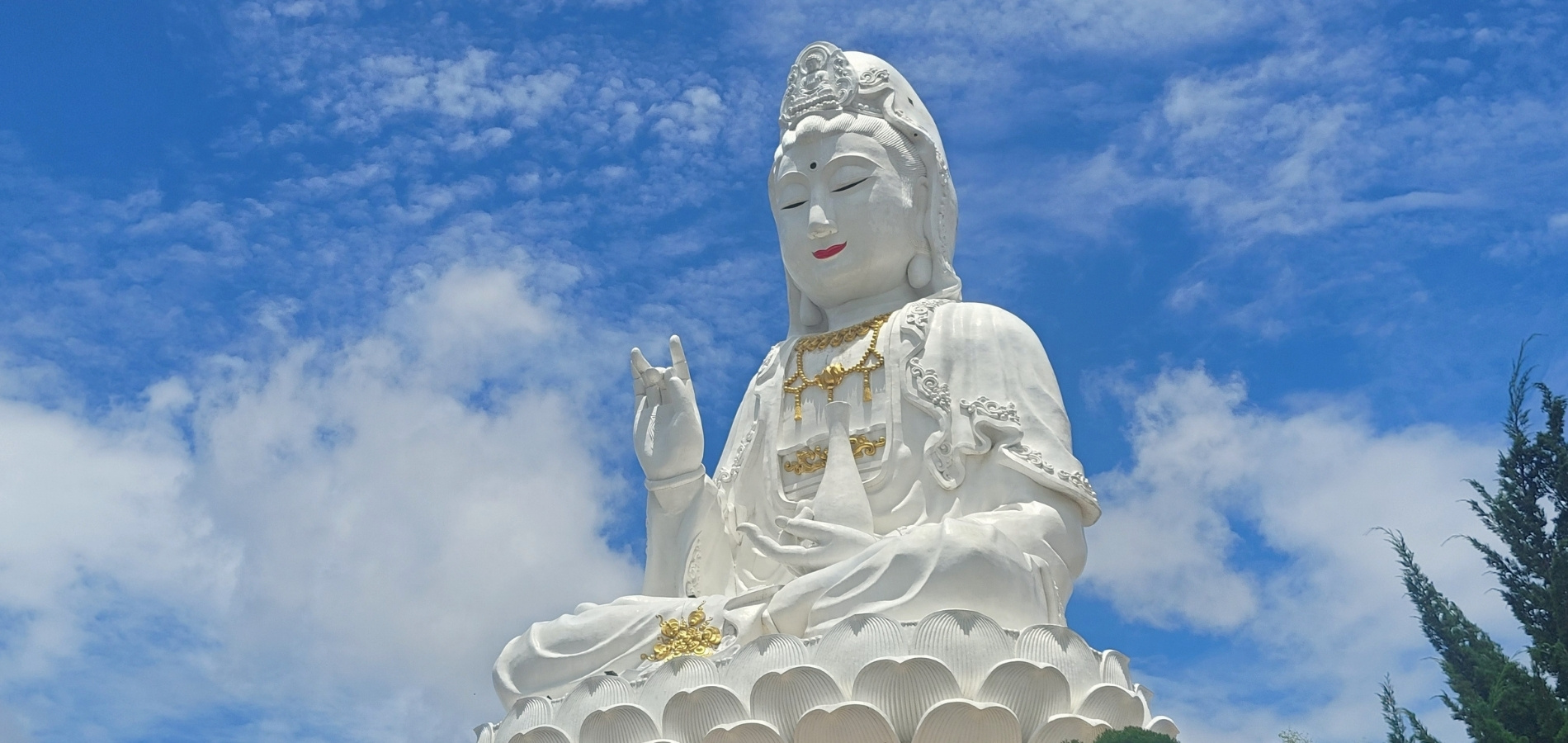
Approaching by road, you spot her from afar. A white, immense silhouette, sitting on a lotus above the rice fields. Most visitors think it is a Buddha. It is actually Guanyin, the Goddess of Compassion in Mahayana Buddhism, a branch highly present among the Chinese communities of Southeast Asia.
A goddess from China
Guanyin is a bodhisattva: a being who has achieved awakening but has chosen to remain in the world to guide humanity. Her presence in this Thai temple reflects the historical influence of the Chinese diaspora in the north of the country, strongly linked to exchanges with the neighboring Yunnan province.
Wat Huay Pla Kang is a rare example of a fusion between Lanna Thai and Chinese Buddhist architectures. This gives it a truly distinct atmosphere, different from all the other temples in Chiang Rai.
The complex was built starting in 2001 under the supervision of the monk Phra Ajarn Phob Chok. In addition to the statue of Guanyin, it includes a nine-story pagoda and an assembly hall with colorful tiled walls of astonishing brightness.
Climbing inside the head of a goddess
This is the experience that children often remember as their favorite. An elevator goes up inside the statue to the 25th floor. The view from the top is remarkable: the surrounding mountains, the rice fields as far as the eye can see, and Chiang Rai in the distance. Teenagers love the unusual nature of the route. The youngest are often fascinated by the dragons guarding the entrance to the pagoda.
Practical info
8 km northwest of the city center. No direct public transport, a taxi or Grab from the center costs about 150 baht. Entrance to the site is free; only the elevator requires a fee: 40 baht. Open every day from 7:00 AM to 9:00 PM.
Wat Phra Kaew: where it all began
Wat Phra Kaew is the only truly ancient temple on this list. And probably the most important from a historical standpoint, not only for Chiang Rai but for the whole of Thailand. Yet, it is often neglected, overshadowed by contemporary temples. This is a real mistake.
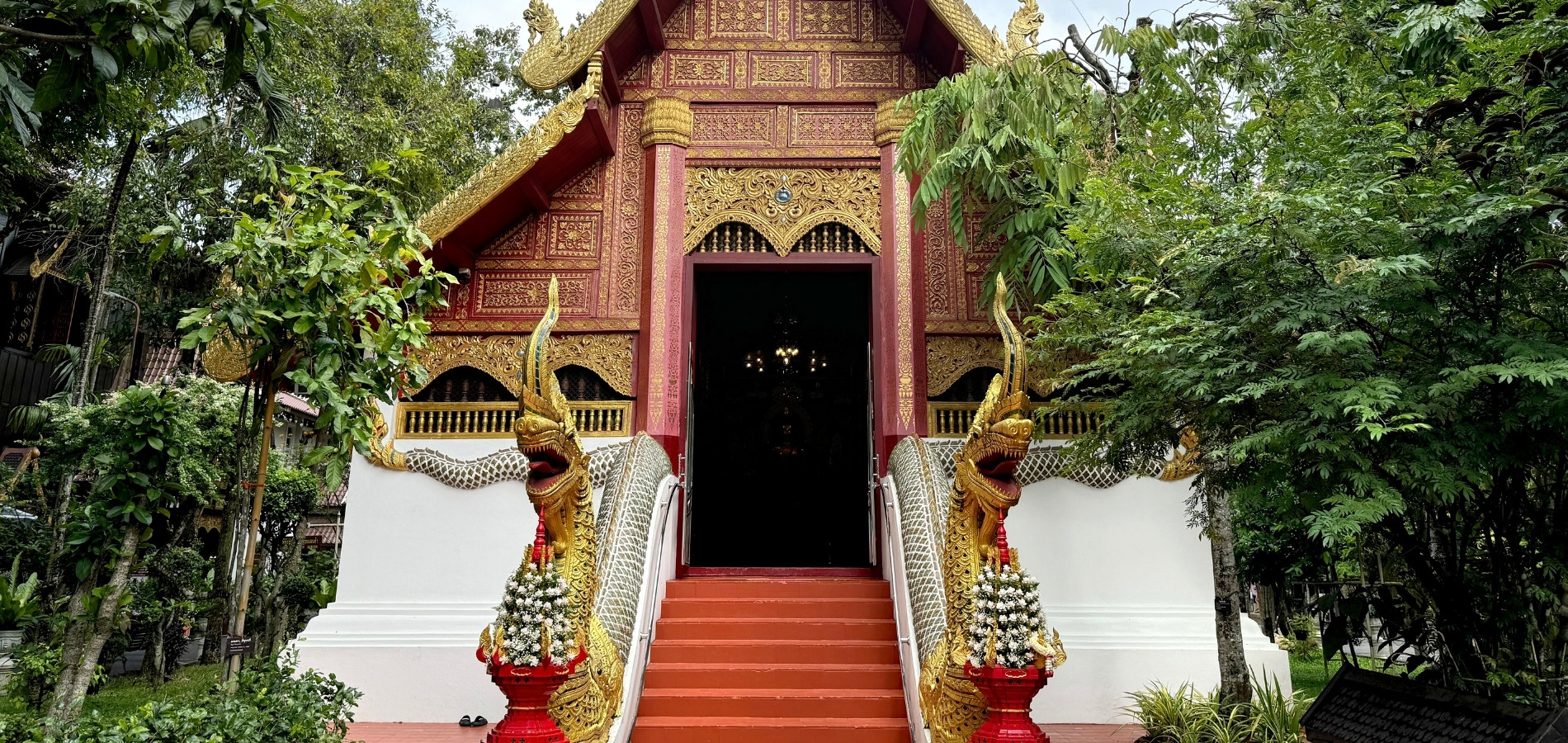
The discovery that changed everything
In 1434, lightning struck the main stupa of the temple. The structure cracked open and revealed a Buddha statue hidden under stucco. Noticing that the stucco was flaking off at the nose, the abbot of the temple discovered that the statue was carved from a block of translucent green stone. It was named the Emerald Buddha; the stone is actually jade, but the name stuck.
What follows reads like a novel. Several kingdoms fought over the statue for centuries. It traveled through Lampang, Chiang Mai, then Luang Prabang and Vientiane, before being installed in Bangkok in 1784. It is still there today, within the grounds of the Grand Palace. It is now the religious emblem of the entire Thai royal dynasty.
And it is here, in Chiang Rai, that it all began.
The most precious replica in the country
To mark this historical link, a replica was commissioned in 1990 for the 90th birthday of the Princess Mother, carved from a block of jade originating from Canada. It is housed in a Lanna-style pavilion, known as Phra Yok Chiang Rai, the Jade Buddha of Chiang Rai.
There are thousands of replicas of the Emerald Buddha throughout the kingdom, but this one is the only one located at the exact spot where the original statue was discovered. That is why it is considered the most precious of all.
The temple also houses a centuries-old bronze statue, and a two-story museum in a teak building featuring Lanna art objects, alms bowls, and ceremonial costumes.
Practical info
Right in the city center, a few minutes' walk from the Clock Tower, Chiang Rai's iconic clock, which changes color to the sound of music every evening. Entrance is free. Allow one hour on site.
This is the most suitable temple for families with young children and for seniors: a single-level, shaded, calm site without crowds.
Preparing for your visit well
Dress code
The rule is the same in all Thai temples: shoulders and knees covered, for both men and women. Shorts, tank tops, and short dresses are refused at the entrance, without exception.
Our advice: always slip a sarong or a large scarf into your bag. Made of cotton or linen, it takes up no space and will get you out of trouble every time. For shoes, sandals that are easy to remove are your best allies, as you will take them off at the entrance of each prayer hall. Young children benefit from a bit more flexibility regarding attire. Teenagers, however, are subject to the same rules as adults.
The ideal order for a day
To see all four temples without rushing, here is the sequence we recommend:
White Temple right at 8:00 AM, before the arrival of the groups.
Wat Huay Pla Kang in the mid-morning.
Wat Phra Kaew after lunch, in the city center.
Blue Temple at the end of the day, for the night lighting.
A well-paced single day is enough. And if you have more time, each temple deserves a return visit.
Here is the complete translation of your text into English, without any modifications, omissions, or shortcuts:
Chiang Rai, in Thailand, holds a surprise for first-time visitors. Not much is expected from this northern city, which is often overshadowed by Chiang Mai. And then, you stumble upon a completely white temple encrusted with mirrors, another of a sapphire blue that exists nowhere else in Thailand, and a 70-meter goddess towering over the rice fields. In just a few decades, the city has become one of the most original places in the country. What makes these temples even more interesting is that they look like nothing else known. They are neither ruins nor frozen monuments. They are living works, driven by visionary artists and monks, that continue to evolve. But they are also active places of worship. Monks live there, worshippers pray there every morning, and every architectural detail carries a precise spiritual meaning. Knowing what you are looking at changes the entire visit.
How to get to Chiang Rai From Chiang Mai, the Green Bus company connects the two cities from Bus Terminal 3, several times a day. The journey takes between 3 and 5 hours depending on the ticket class, starting at around 200 baht. The route goes through mountain landscapes that are well worth the detour. From Bangkok, flying is clearly the best option. A flight of about 1 hour and 30 minutes, notably with AirAsia or Nok Air. Mae Fah Luang Airport is 8 km from the city center, served by a local bus for 20 baht from the arrivals area. On-site, renting a scooter costs about 200 baht a day. This is the easiest way to go from one temple to another, as they are all within a 15 km radius around the center. For those who prefer not to drive, a day-long tuk-tuk is a good alternative. Expect to pay 800 to 1,000 baht depending on the itinerary.
Wat Rong Khun: the White Temple This is the most recognizable image of Chiang Rai. Perhaps even of the entire Thai north. Wat Rong Khun, which everyone calls the White Temple, is covered in white plaster and encrusted with thousands of mirror fragments. In bright sunlight, it sparkles. No other temple in Thailand looks like it.
An artist, a tribute, an endless project There is nothing ancient about this temple. Its construction began in 1997, at the initiative of an artist originally from Chiang Rai, Chalermchai Kositpipat. His project: to pay tribute to King Bhumibol and to offer his city an extraordinary monument. He financed the work using his own funds, refusing all donations exceeding 10,000 baht to avoid depending on anyone and to make no concessions regarding his vision. The completion of the work is estimated to be around 2070, very likely after his death. The White Temple is a work in perpetual progress, and that is precisely what makes it unique.
What you will see To reach the main building, you cross a bridge over a pond dotted with hands reaching toward the sky. These hands represent suffering souls crying out for their deliverance, a Buddhist image of the cycle of rebirths and the passage between the world of desires and that of awakening. The white symbolizes the purity of Buddha. The thousands of mirror fragments, the wisdom that radiates into the world. Inside, a surprise awaits those who do not expect it. The murals blend Buddhist iconography with contemporary culture: Batman, science fiction movie characters, and commentaries on current world issues stand alongside representations of karma and awakening. This is the deliberate choice of the artist, who is convinced that spirituality must dialogue with its time.
Good to know: photos are forbidden inside the main building. Our advice: arrive right at opening time at 8:00 AM. Tour groups show up mid-morning, and the site quickly becomes very crowded. Early in the morning, the light on the mirrors is also much more beautiful.
Practical info The temple is 13 km south of Chiang Rai, about fifteen minutes by scooter. A songthaew, a shared local bus, leaves from Terminal 1 for 20 baht. By tuk-tuk from the center, expect 300 baht round trip including waiting time. The entrance fee is 200 baht. Open Monday to Friday from 8:00 AM to 5:00 PM, Saturday and Sunday until 5:30 PM. Allow 1 hour and 30 minutes for the full visit: temple, bridge, gardens, painting museum, and gallery. 45 minutes is enough if you are in a hurry. The site is highly accessible for families: flat ground, generous space. The extravagant sculptures captivate children, and teenagers often love the quirky side of the place.
Wat Rong Suea Ten: the Blue Temple 6 km north of the city center, there is a temple that many travelers miss out on, due to lack of time or information. Its color is its primary signature. Not a pastel blue nor a pale blue: a deep sapphire blue that pops against the Chiang Rai sky. From the facade down to the smallest details of the interior murals, everything is bathed in this intense hue, enhanced by flamboyant gilding.
The story of the tigers The name of the temple means "the house of the leaping tiger." This is not a metaphor. For a long time, this abandoned wat served as a playground for tigers that regularly crossed the nearby river to rest there, much to the dismay of the villagers. These felines have since disappeared from the territory, but they left their name to the place. The main building was only completed in 2016. Its creator, Phuttha Kabkaew, is a student of the master of the White Temple. One finds a very similar style in the interior murals: detailed paintings representing the Buddhist heavens, with a large white porcelain Buddha reigning in the center of the prayer hall. The contrast between this immaculate white and the electric blue that surrounds it is striking. The atmosphere there is calmer than at the White Temple. Fewer groups, more local worshippers. We recommend coming in the late afternoon. The temple is open until 8:00 PM, and as soon as night falls, the lighting further accentuates the deep blue of the facades. An image difficult to forget.
Practical info In the Rim Kok sub-district, about ten minutes by scooter from the center. Entrance is free. Open every day from 7:00 AM to 8:00 PM.
Wat Huay Pla Kang: the 70-meter goddess Approaching by road, you spot her from afar. A white, immense silhouette, sitting on a lotus above the rice fields. Most visitors think it is a Buddha. It is actually Guanyin, the Goddess of Compassion in Mahayana Buddhism, a branch highly present among the Chinese communities of Southeast Asia.
A goddess from China Guanyin is a bodhisattva: a being who has achieved awakening but has chosen to remain in the world to guide humanity. Her presence in this Thai temple reflects the historical influence of the Chinese diaspora in the north of the country, strongly linked to exchanges with the neighboring Yunnan province. Wat Huay Pla Kang is a rare example of a fusion between Lanna Thai and Chinese Buddhist architectures. This gives it a truly distinct atmosphere, different from all the other temples in Chiang Rai. The complex was built starting in 2001 under the supervision of the monk Phra Ajarn Phob Chok. In addition to the statue of Guanyin, it includes a nine-story pagoda and an assembly hall with colorful tiled walls of astonishing brightness.
Climbing inside the head of a goddess This is the experience that children often remember as their favorite. An elevator goes up inside the statue to the 25th floor. The view from the top is remarkable: the surrounding mountains, the rice fields as far as the eye can see, and Chiang Rai in the distance. Teenagers love the unusual nature of the route. The youngest are often fascinated by the dragons guarding the entrance to the pagoda.
Practical info 8 km northwest of the city center. No direct public transport, a taxi or Grab from the center costs about 150 baht. Entrance to the site is free; only the elevator requires a fee: 40 baht. Open every day from 7:00 AM to 9:00 PM.
Wat Phra Kaew: where it all began Wat Phra Kaew is the only truly ancient temple on this list. And probably the most important from a historical standpoint, not only for Chiang Rai but for the whole of Thailand. Yet, it is often neglected, overshadowed by contemporary temples. This is a real mistake.
The discovery that changed everything In 1434, lightning struck the main stupa of the temple. The structure cracked open and revealed a Buddha statue hidden under stucco. Noticing that the stucco was flaking off at the nose, the abbot of the temple discovered that the statue was carved from a block of translucent green stone. It was named the Emerald Buddha; the stone is actually jade, but the name stuck. What follows reads like a novel. Several kingdoms fought over the statue for centuries. It traveled through Lampang, Chiang Mai, then Luang Prabang and Vientiane, before being installed in Bangkok in 1784. It is still there today, within the grounds of the Grand Palace. It is now the religious emblem of the entire Thai royal dynasty. And it is here, in Chiang Rai, that it all began.
The most precious replica in the country To mark this historical link, a replica was commissioned in 1990 for the 90th birthday of the Princess Mother, carved from a block of jade originating from Canada. It is housed in a Lanna-style pavilion, known as Phra Yok Chiang Rai, the Jade Buddha of Chiang Rai. There are thousands of replicas of the Emerald Buddha throughout the kingdom, but this one is the only one located at the exact spot where the original statue was discovered. That is why it is considered the most precious of all. The temple also houses a centuries-old bronze statue, and a two-story museum in a teak building featuring Lanna art objects, alms bowls, and ceremonial costumes.
Practical info Right in the city center, a few minutes' walk from the Clock Tower, Chiang Rai's iconic clock, which changes color to the sound of music every evening. Entrance is free. Allow one hour on site. This is the most suitable temple for families with young children and for seniors: a single-level, shaded, calm site without crowds.
Preparing for your visit well Dress code The rule is the same in all Thai temples: shoulders and knees covered, for both men and women. Shorts, tank tops, and short dresses are refused at the entrance, without exception.
Our advice: always slip a sarong or a large scarf into your bag. Made of cotton or linen, it takes up no space and will get you out of trouble every time. For shoes, sandals that are easy to remove are your best allies, as you will take them off at the entrance of each prayer hall. Young children benefit from a bit more flexibility regarding attire. Teenagers, however, are subject to the same rules as adults.
The ideal order for a day To see all four temples without rushing, here is the sequence we recommend:
White Temple right at 8:00 AM, before the arrival of the groups.
Wat Huay Pla Kang in the mid-morning.
Wat Phra Kaew after lunch, in the city center.
Blue Temple at the end of the day, for the night lighting.
A well-paced single day is enough. And if you have more time, each temple deserves a return visit.