Visiting Ayutthaya: the 5 temples not to miss

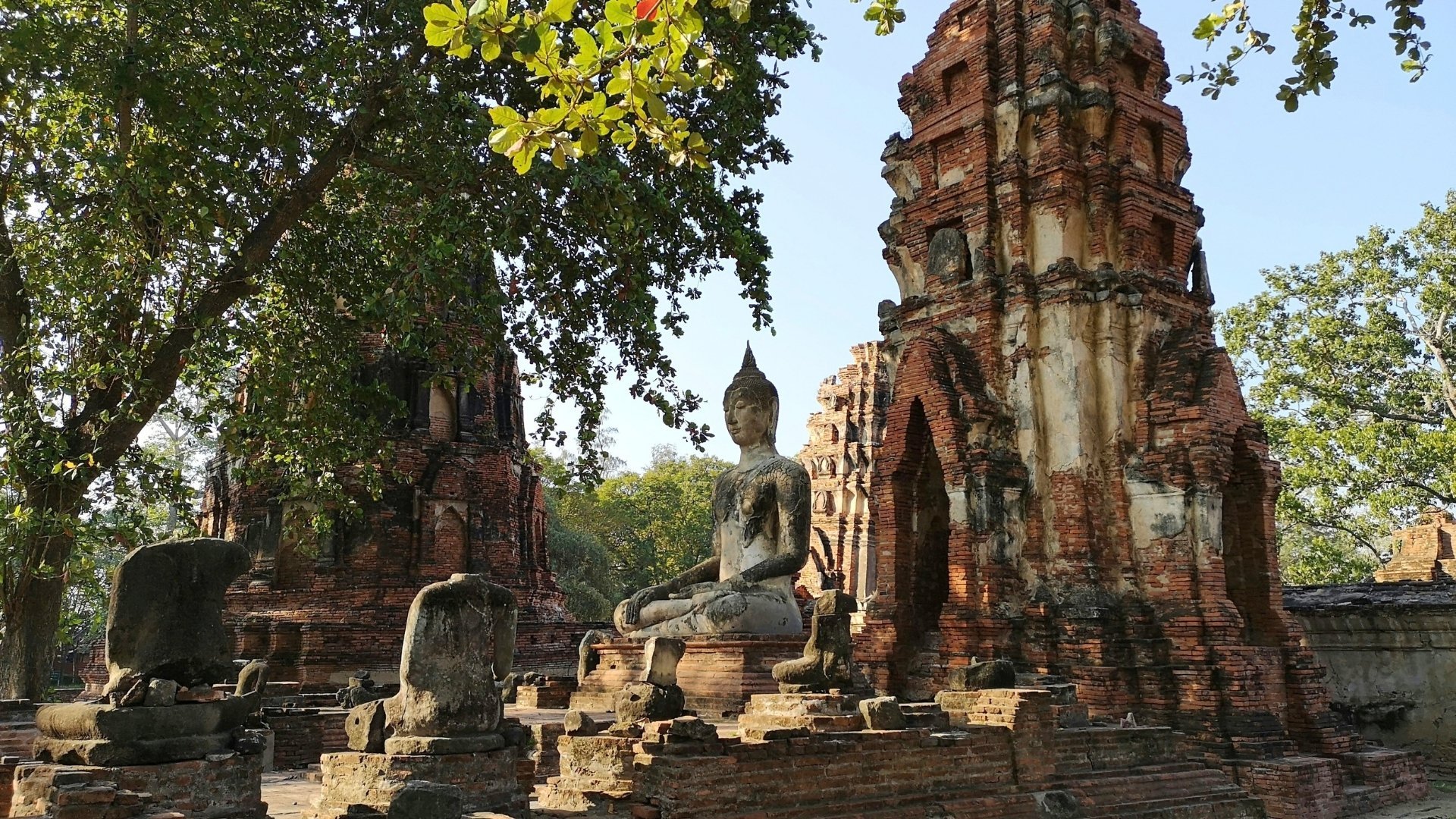
Eighty kilometres north of Bangkok lies Ayutthaya, the former capital of the kingdom of Siam. What remains today are red-brick prangs standing among the trees and long rows of seated Buddhas, all scattered across a thoroughly living city. It is one of the essential destinations on a trip to Thailand, especially for culture lovers! So here are the five temples that are truly worth the detour.
Ayutthaya, the former capital of Siam
Ayutthaya was founded in 1351 and served as the capital of the kingdom of Siam for more than four centuries. At its height, it was one of the most populous and most cosmopolitan cities in Asia, with Portuguese, Japanese, Dutch and Chinese quarters established along the rivers. In 1767, a Burmese army took the city and destroyed it. The temples were burned, the libraries and royal archives went up in smoke, and the Buddha statues were systematically beheaded and stripped of the gold that covered them. The great Buddha of Wat Phra Si Sanphet, sixteen metres tall, was even melted down for its metal. The court withdrew further south, to Thonburi and then to Bangkok, and Ayutthaya was never rebuilt. That is precisely what gives it its power today: despite the destruction, the might of the old capital remains clearly visible.
The site has been inscribed on the UNESCO World Heritage List since 13 December 1991, under the name "Historic City of Ayutthaya". Access to the park itself is free, but the major temples charge an entrance fee (around 50 baht per temple, or a combined pass that covers six of them). The historical park is not, in fact, an enclosed site. It is a modern city of several tens of thousands of inhabitants, surrounded by three rivers: the Chao Phraya, the Pa Sak and the Lopburi. The temples are spread throughout the city, which has grown up among the ruins, so you need to travel between each site by bicycle or tuk-tuk.
The 5 must-see temples of Ayutthaya
Before going into detail, here are a few important reminders. Many visitors think dress codes apply only to working temples, but they apply in the ruins too. Shoulders and knees must be covered, and shoes must be removed before entering the buildings. Even in a ruined state, these monuments remain sacred places for Buddhists.
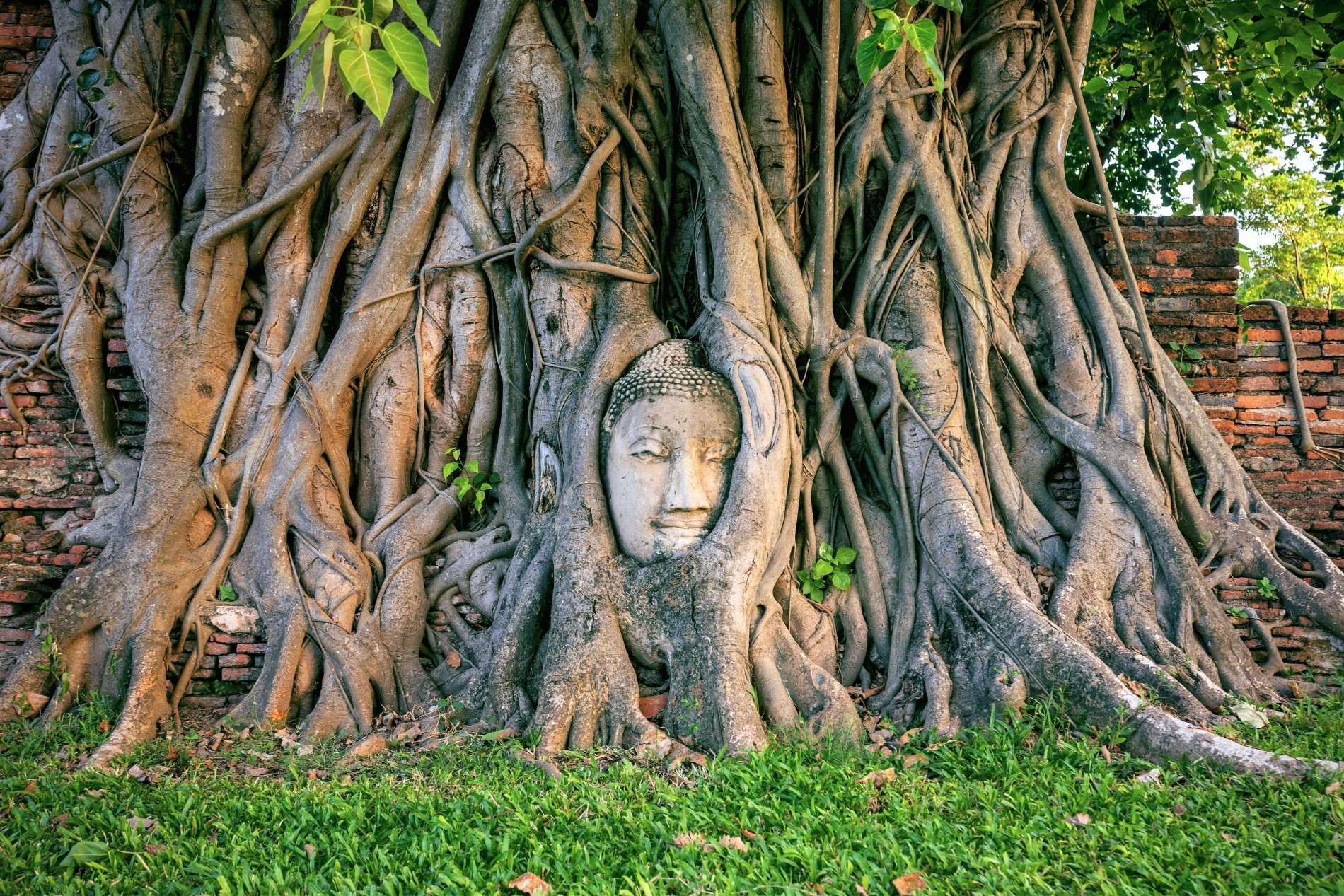
Wat Mahathat and its Buddha head caught in the roots
This is the image everyone knows from Ayutthaya: a sandstone Buddha head gripped by the roots of a fig tree that has grown around it over the centuries. But no one knows exactly how it got there. Getting too close is forbidden, however, and photos must be taken crouching or kneeling, so that your head is lower than the Buddha's.
The rest of the complex deserves just as much attention. Wat Mahathat was one of the most important monasteries in the kingdom and the seat of the Buddhist patriarch. What remains is the base of a collapsed prang, rows of leaning chedis and a long series of beheaded Buddha statues.
Visit it first thing in the morning, before the coaches arrive from Bangkok.
 |  |
Wat Phra Si Sanphet, the royal temple with three chedis
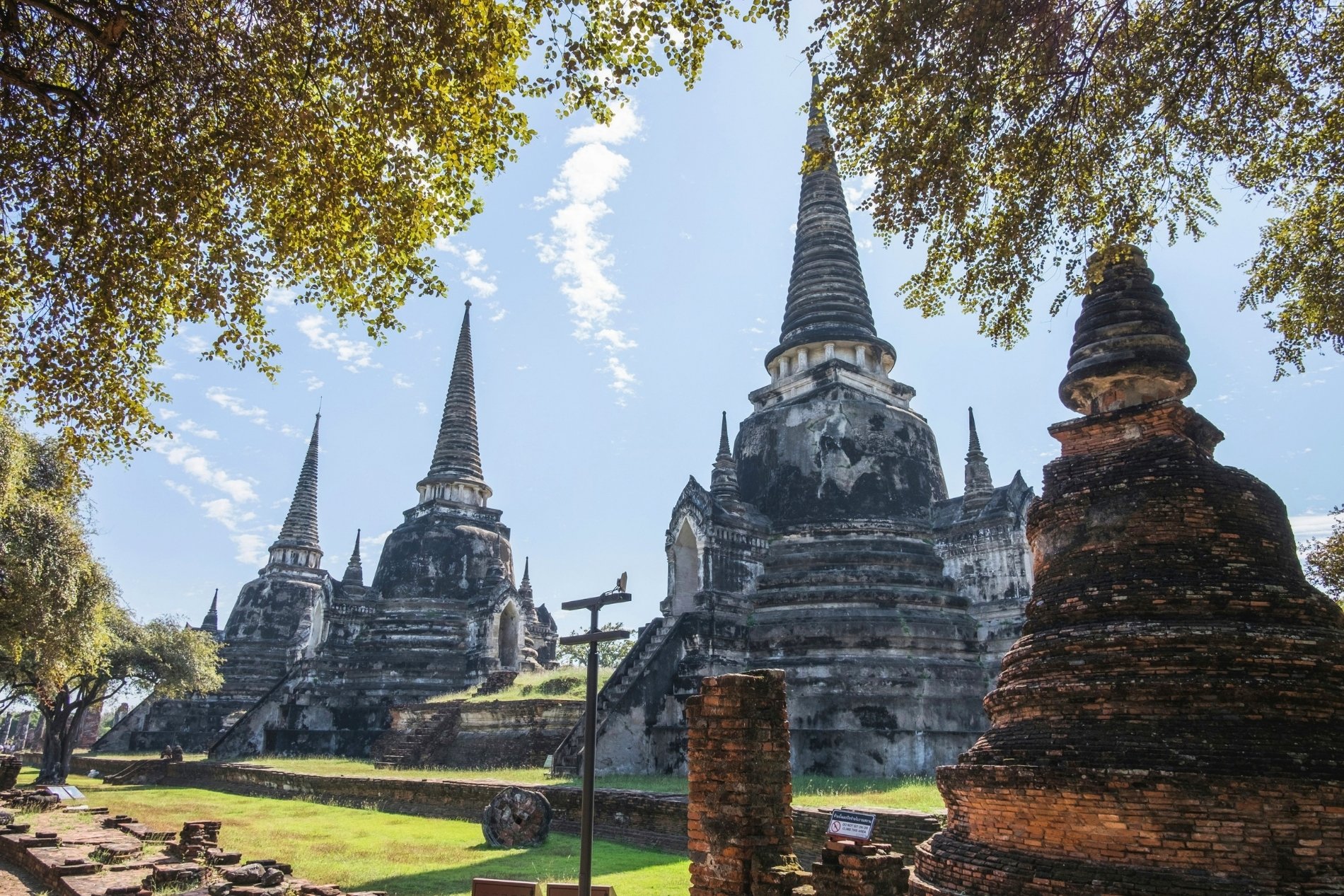
Wat Phra Si Sanphet consists of three white chedis in a row, perfectly symmetrical. It was the kings' private temple, located within the palace itself. No monks lived there, as it was used for royal ceremonies. Later, it went on to inspire Wat Phra Kaeo at the Grand Palace in Bangkok.
The chedis hold the ashes of several sovereigns. The temple also housed a standing Buddha statue 16 metres high, covered in gold, which was melted down by the Burmese for its metal. Right next door is Wihan Phra Mongkhon Bophit, a prayer hall sheltering a large black bronze Buddha. Entry is free, and it makes a good shaded stop between two sets of ruins.
Wat Chaiwatthanaram, the most beautiful at the end of the day
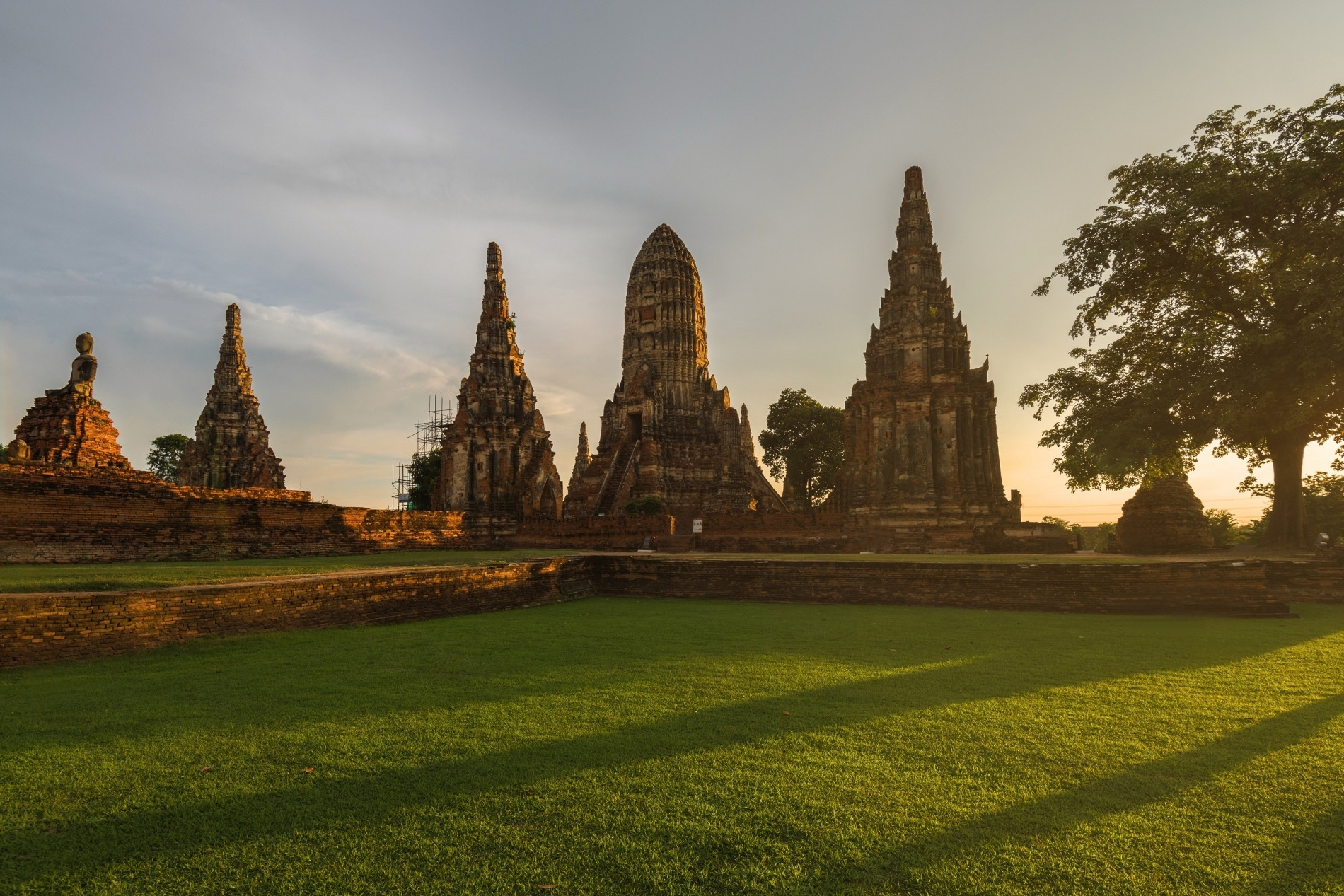
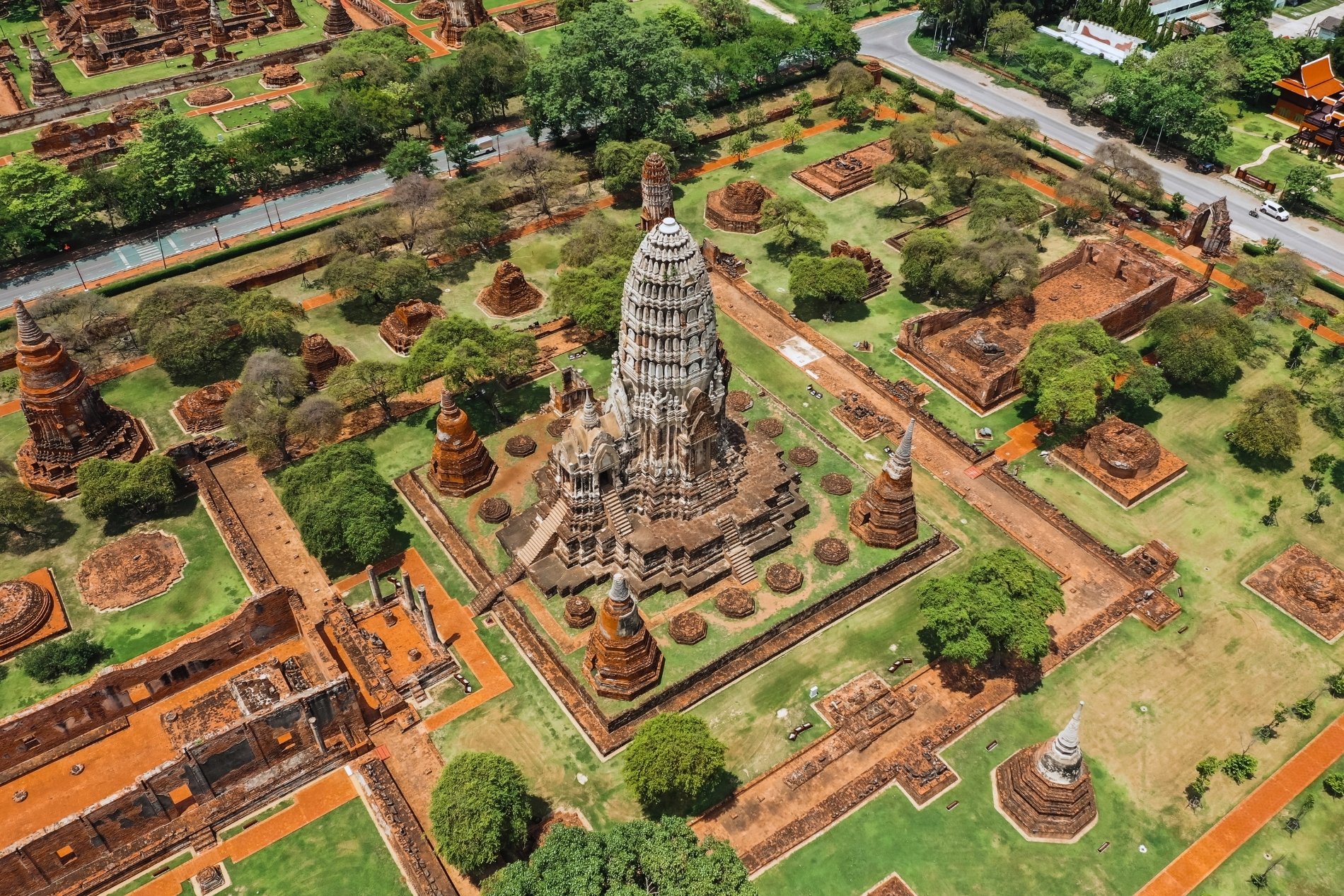
Set on the west bank of the Chao Phraya, this temple was built in 1630 during the reign of King Prasat Thong, in a Khmer-inspired style. It features a large central prang surrounded by eight chapels and secondary prangs, the whole ensemble facing the river. Facing due west, it catches an orange light in the late afternoon that no other site in Ayutthaya can offer. This is the site we recommend to our travellers as the last visit of the day.
Around the temple, several shops rent traditional Thai costumes for photo shoots, with prices starting from 300 baht.
 |  |
Wat Ratchaburana and its painted crypt
Directly opposite Wat Mahathat stands the temple with the most novelistic history in the park. In 1424, on the death of King Intharacha, two of his sons fought a duel on elephant back over the succession and both lost their lives. It was a third brother, Borommarachathirat II, who ascended the throne and had this temple built on the site of their cremation.
The crypt of the central prang was looted in 1957. The thieves were arrested, part of the treasure recovered, and the following year the Fine Arts Department undertook excavations that brought to light a large number of precious objects, now displayed at the Chao Sam Phraya National Museum. You can climb the prang's very steep outer staircase up to the chamber built halfway up, then take another staircase down into the crypt, where 15th-century murals still survive.
Wat Yai Chai Mongkhon, a still-active temple
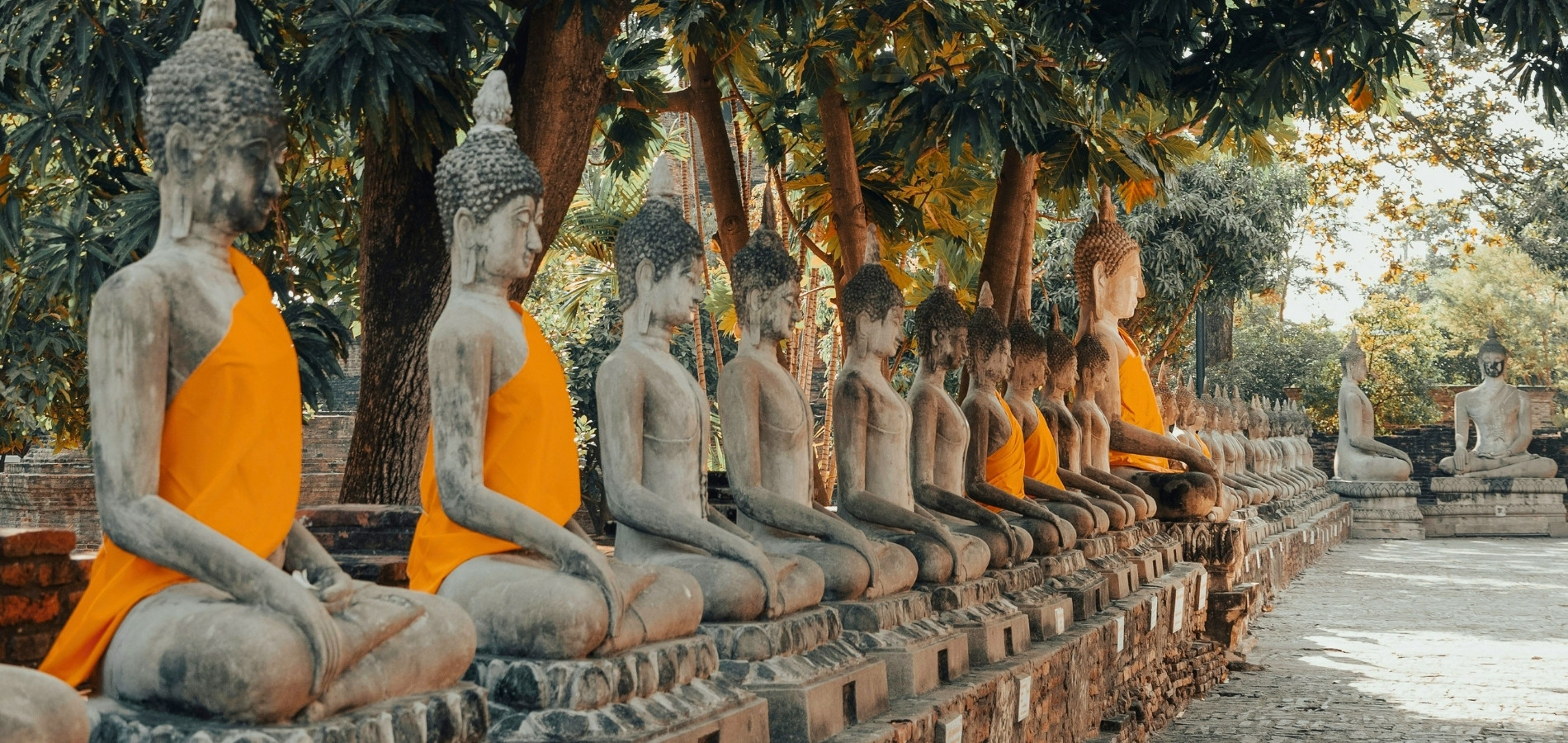
Wat Yai Chai Mongkhon is a working monastery, with monks, worshippers, incense and offerings. Its large bell-shaped chedi dominates the entire eastern side of the city. King Naresuan had it built in 1592 to commemorate his victory over the Burmese crown prince. You can climb the steps to the upper platform, from where the view stretches far across the surrounding countryside. All around the cloister, dozens of seated Buddha statues are draped in saffron cloth.
It is worth noting that this temple is located a little further out, so you need to allow time for the journey. And its entrance ticket costs 20 baht (and is not included in the combined pass).
If you have more time, two sites round out this selection nicely: Wat Lokayasutharam, which is home to a large reclining Buddha in brick and stucco, in the open air, and Wat Phu Khao Thong, a large white chedi that you can climb.
What to do in Ayutthaya besides the temples
Ayutthaya is not just about its temples. There is plenty to keep you busy if you stay more than a day.
At the end of the day, we recommend boarding a traditional rice barge for a sunset cruise. You can see the riverside temples reflected in the water with the orange sky in the background. For the rest of the trip, you can enjoy the slow pace and watch life along the water: stilt houses, fishermen and more.
It can also be worth visiting the Chao Sam Phraya National Museum, which opened in 1961. It was designed to house the treasures discovered in the crypts of Wat Ratchaburana and Wat Mahathat: relics, jewellery, gold objects and votive tablets. This building, dedicated to the goldsmithing of Ayutthaya, displays more than 2,200 gold pieces from archaeological sites in the province.
Finally, the night market is an essential stop. Set up near the river in the evening, it is a local market serving genuinely typical dishes, such as boat noodles (kuay teow ruea, the Ayutthaya speciality), grilled pork skewers (moo ping), oyster omelettes and banana roti.
Ayutthaya offers elephant rides around the city, but we strongly advise against this activity. Carrying passengers on a howdah and walking on asphalt in the full heat is no small matter for the animal. If you would like to encounter elephants during your stay, there are observation sanctuaries and national parks elsewhere in the country, with no forced contact or rides, which we can build into your itinerary.
Our practical tips for visiting the temples of Ayutthaya
How to get to Ayutthaya?
From Bangkok, the train is the simplest and most economical option. Departures are mainly from Krung Thep Aphiwat central station, with ordinary trains from 15 baht in 3rd class (1 hr 30 to 2 hrs journey time), and express trains for 65 to 125 baht (around 1 hour). On arrival, the station is on the opposite bank from the temples. You simply take a small ferry across the Pa Sak for a few baht.
A private car with driver takes about an hour door to door. This is the option we favour for our travellers, particularly for families with children.
It is also possible to reach Ayutthaya by boat. From Bangkok, there are cruises on the Chao Phraya, but the upriver journey takes half a day.
When to visit Ayutthaya?
The cool season, from November to February, is by far the most pleasant time to visit a cultural destination like Ayutthaya. Temperatures stay comfortable during the day, which allows you to wander easily from temple to temple and enjoy the visit. It is also the season of the night-time illuminations.
From March to May, the heat can be really hard going on a site with no shade. But the rainy season, from June to October, remains perfectly manageable, as the downpours are often brief.
The time of your visit, on the other hand, matters a great deal. Most temples open at 8 am and the first coaches from Bangkok arrive between 9.30 and 10.30 am. The morning window is therefore the best, both for the heat and for the peace and quiet. The other good time is late afternoon, from 3.30 pm, when the light turns low and golden and the groups have left.
Opening hours vary from one temple to another. Some close as early as 4.30 pm, while others remain accessible until early evening. Check site by site before planning your day.
How much time to allow?
Half a day in Ayutthaya allows you to see about three temples. That is short, but it can make sense if the stop fits into a journey heading north. A full day covers the five temples in this selection. But a night on site is what we recommend as soon as the pace of the trip allows, and particularly for a family trip to Thailand. It lets you split the visit across two cool mornings, and enjoy the sunset on a rice barge cruise.
How to get around once there?
The city-centre temples are one to two kilometres apart. We recommend renting a bicycle, for 50 to 100 baht a day. It is very pleasant to ride around the city's quiet little lanes, but it can be a little dangerous for small children. In that case, we recommend the tuk-tuk, which remains the most practical solution for most visitors.
Tickets, prices and combined pass
Entry to the historical park is free, but the major temples charge 50 baht per person for foreign visitors, and some smaller sites 20 baht.
A combined pass at 220 baht covers six temples: Wat Mahathat, Wat Ratchaburana, Wat Phra Si Sanphet, Wat Phra Ram, Wat Chaiwatthanaram and Wat Maheyong. It can be bought at the ticket office of any of these six sites and remains valid for 30 days from purchase. It becomes worthwhile from five temples visited onwards.
One small point: there is no cash machine inside the park, the nearest ones being in the city centre near the station. So bring cash with you.
Organising your visit to Ayutthaya with a local agency
Ayutthaya is a stop you can do on your own, but the real question is not whether it is possible, it is how it fits in with the rest of your trip. Based in Thailand, ÔDASIE builds tailor-made, entirely private itineraries, with vehicle and driver, French-speaking guides and accommodation chosen one by one. For Ayutthaya, this translates into very concrete things, such as setting off early enough to have Wat Mahathat to yourself, or ending the day in style facing the sunset.
If you are planning a trip to Thailand and would like Ayutthaya to find its rightful place in it, let's talk about your project. We build every itinerary around your wishes, your pace and the season in which you are travelling.
